


Red Squirrel Ecology
Red squirrels (Sciurus vulgaris) are small and arboreal weighing up to 300g. The UK's only native squirrel, their natural range includes Europe and parts of Asia. Food and habitat: Living in broadleaf and conifer forests, they are specialised herbivores, feeding on pine seeds, hazel nuts, tree shoots, berries and fungi. They are even known to collect fungi, dry it and store it. Red squirrels need a variety of tree species and ages to ensure a continuous supply of nuts and seeds. In years when there is a shortage of tree seeds, squirrels can die of starvation. Activity: They don't hibernate, depending on food they have hidden in the autumn to see them through winter. They're more active during the day, although they may rest in the middle of the day if it is hot, or if they are caring for young. Dreys: They build dome shaped 'Dreys' high up in trees, using twigs, moss and leaves. Often squirrels will build several dreys in their home ranges for resting and will build a larger drey for breeding. Mating: Usually starts in January, with males calling to females and chasing females around trees! Breeding: Given optimal conditions, red squirrels usually produce two litters a year: one in February/March and if conditions remain favourable, a second in May/June or July/August. Typically they have three or four young (kittens or kits) per litter. Whether females produce a second litter depends her physical condition and the availability of food. Males play no part in caring for the young. Gestation and Birth: Pregnancy lasts 5 to 6 weeks with kits being born blind and hairless. At 7 weeks the young kits begin to venture away from the drey and are usually weaned around 8 to 10 weeks and become independent. Disturbance: Red squirrels are considered to have a high risk or disturbance during the breeding season (February to September) so care should be taken and forestry or tree related work should not take place during these months if red squirrels are present. Females have been known to abandon their nests or try and move kits to a safer location if disturbed, risking the young and adult squirrels. Predation: Red squirrels are more vulnerable to predators when they are on the ground or in the open. Hence they will often use hedgerows, stone walls and fence lines to move through the landscape between woodlands. This is another reason that forestry operations need to be undertaken with care and why continuous cover forestry is preferable to clear fell forestry where there are populations of red squirrels using the woodlands.
Grey Squirrel Ecology
Grey squirrels (Sciurus carolinensis) are a non native invasive species in the UK. They are nearly twice the weight of our native red squirrel usually weighing around 600 g. Naturally native to the north eastern United States, they were introduced to the UK in the late 19th century. They outcompete our native red squirrels for food and habitat, as well as spreading the squirrel pox virus which is lethal to our red squirrels but does not harm greys. Food and habitat: Grey squirrels are opportunistic omnivores, feeding on nuts, shoots and fungi. They also feed on insects, bird eggs and young birds. They usually live in broadleaved woodlands containing oak, beech, sweet chestnut and hazel. They cannot survive in primarily coniferous woodland as pinecone seeds are too small to sustain them. Activity: Like red squirrels, grey squirrels are diurnal and build dreys high up in trees, usually below the canopy. However, they sometimes nest inside roof cavities and can do a lot of damage to people's homes. Mating and breeding: Grey squirrels usually mate in January/February and again in June/July but they have been known to breed all year round. Grey squirrels can breed when they are one year old. Gestation and Birth: The gestation season is typically about 44 days. Females can produce between one and eight young although four is the average number for a litter. They are usually fully weaned at around 10 weeks. Disturbance: Like red squirrels, greys will attempt to move their young if their breeding dreys or surrounding woodland are disturbed. Predation: Pine martens are one of the largest threats to grey squirrels. Grey squirrels are heavier and less agile than red squirrels which means that Pine martens find greys easier prey (compared to our native red squirrels). In addition, pine martens are not found in grey squirrel's native range, so greys are naive to the threat that pine martens pose. Whereas red squirrels have evolved with the pine marten (which is a native UK predator)hence reds have a natural fear of pine martens, and being lighter, red squirrels can escape more easily.

Red Squirrels and the Law
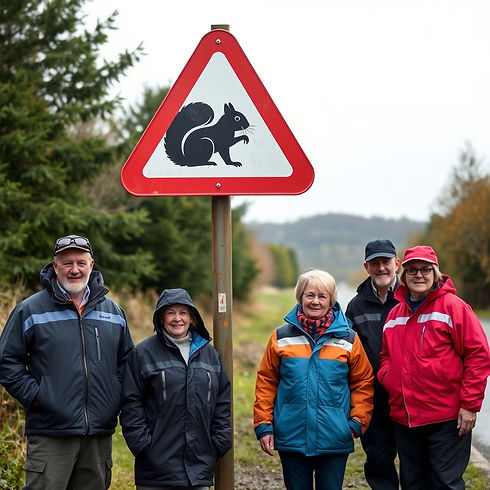
Red squirrels are a Protected Species under schedules 5 and 6 of the 1981 Wildlife and Countryside Act. It is an offence to kill or injure red squirrels, or to damage or disturb dreys or other structures being actively used by red squirrels for shelter. Pressures on red squirrels include: Habitat loss and fragmentation Timber harvesting and woodland clearance Severe winters Lack of food (poor mast and seed years) Traffic accidents Pet predation Natural predation If anyone needs to undertake felling and forestry operations during the red squirrel breeding season (February to September) a Red Squirrel Licence will be needed to ensure that full environmental impact assessments are undertaken and a mitigation strategy followed to minimise any negative impacts on the breeding red squirrel population. The decision to work in a red squirrel forest during the breeding season must be based upon an objective assessment of the likely impact on squirrels and upon a demonstration that there is no satisfactory alternative. NatureScot grant a limited number of Red Squirrel Licences to private forestry operations after a full assessment. Forestry and Land Scotland grant Red Squirrel Licences to their staff and contractors for forestry work undertaken in publicly owned forests in Scotland. If you are concerned about forestry operations (or anything else you believe is putting red squirrels at risk) please Contact Us or your local Red Squirrel Group.
Science and Research
The development of an oral contraceptive for grey squirrels is an exciting step forward in tackling the challenges they pose to red squirrels. Scientists are currently testing how effective the contraceptive is and how well the species‑selective feeders are at ensuring that only grey squirrels can access the contraceptive. These cleverly designed feeders are a crucial part of the project, helping to keep other wildlife safe while delivering the treatment exactly where it’s needed. Although still in the research phase, this work has huge potential. A safe, targeted, non‑lethal contraceptive could significantly reduce grey squirrel numbers over time, allowing Scotland’s red squirrels the space and protection they need to recover and thrive.
Research into a vaccine for the fatal squirrel pox virus has been carried out in the past, with early research showing potential to protect red squirrels from this devastating disease, which is so often carried by grey squirrels. Although the research did not progress as far as hoped and has not been developed to the same extent as the grey squirrel contraceptive, there is growing support for revisiting this important line of research.
Another important area of research focuses on the positive impact pine martens can have on red squirrel populations. Studies show that when pine martens return to or are introduced into a woodland, red squirrel numbers often increase. This effect is largely due to the pine marten’s influence on grey squirrels: greys are slower, spend more time on the ground, and are far less agile in the canopy, making them much more vulnerable to predation. Red squirrels, being quicker and lighter in the canopy, are far better at evading predation. As grey squirrel numbers fall, competition for food and habitat is reduced, allowing red squirrels to recover and expand their range.


Working together to restore and conserve Red Squirrels
As well as working alongside and supporting the network of 16 volunteer Red Squirrel Groups, who are the lifeblood of red squirrel conservation across southern Scotland, RUN is working with the eight Red Squirrel Recovery Network of partners, including Bright Green Nature and the Galloway and Southern Ayrshire Biosphere in Scotland.
RUN is also working collaboratively with a large number of stakeholders to help deliver better conservation outcomes for red squirrels across southern Scotland:
Government bodies, including Forestry and Land Scotland and NatureScot, to ensure better habitat management and more sensitive forestry practices for red squirrels;
Other conservation charities, including the Scottish Wildlife Trust's Saving Scotland's Red Squirrels project, the Vincent Wildlife's Trust, Martens on the Move project and the Northumberland Wildlife Trust (the Red Squirrel Recovery Network) and the Red Squirrel Forum for South of Scotland;
We also work closely with local communities, landowners, and land managers, including large private estates and private forestry companies. Advising them on trapping grey squirrels, managing their woodlands to increase red squirrel populations and offering engagement in the Trap Loan Scheme and support for Grey Squirrel Control Officers and Red Squirrel Rangers.
If you know of any organisation, community or landowner who would like to help us with our work to protect red squirrels, please contact us.