

HOW WE WORK : Saving Red Squirrels across Southern Scotland
Conservation and Restoration
In 2026 RUN took on the role as one of three Conservation Delivery Partners across Southern Scotland for the Red Squirrel Recovery Network (RSRN) working to conserve red squirrels across the Borders and Dumfries and Galloway.
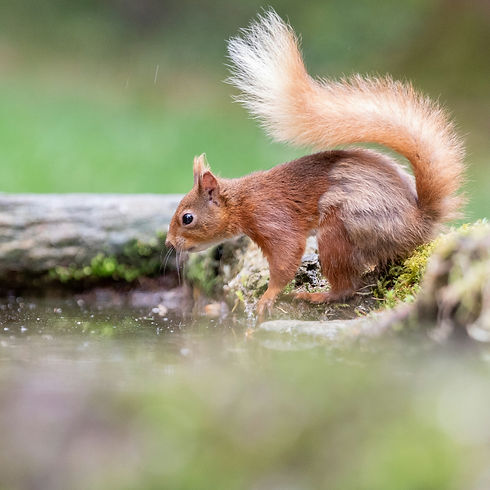
RUN - Working to Restore and Protect Red Squirrels in Southern Scotland
Restoring Upland Nature (RUN) is proud to be part of the Red Squirrel Recovery Network (RSRN), working to increase the numbers of red squirrels across Scotland and to help limit the spread of the deadly squirrel pox virus, by encouraging land owners and communities to report and help manage grey squirrels in their areas.
Building on the dedicated work already undertaken by the network of Volunteer Red Squirrel Groups and Saving Scotland's Red Squirrels team over the last decade, RUN is now working closely with Bright Green Nature and the Galloway and Southern Ayrshire Biosphere (GSAB) to do even more for red squirrel conservation over the next four years.
Working through the RSRN project, RUN will increase direct conservation action for red squirrels, by strengthening and supporting the network of Volunteer Red Squirrel Groups, through the provision of small grants, training, fundraising and communication support, helping them increase their volunteer numbers and encouraging the public and landowners to report their sightings of both red and grey squirrels.
Working with the eight partners of the RSRN project, RUN will be:
-
Raising Awareness
-
Using Evidence Based Science
-
Taking Direct Conservation Action
-
Strengthening Partnership, Policy and Protection
Awareness and Engagement
RUN will be working collaboratively with schools, communities, woodland owners, land managers and other stakeholders to raise awareness about the threats that red squirrels face and how we can work together and take direct action to increase the red squirrel population across southern Scotland.
Watch out for us at summer shows, community events and find out how you can get involved in red squirrel conservation.
Every year, RUN will be encouraging people to volunteer with their local Red Squirrel Groups to get involved in the Spring Squirrel Survey (held March to May each year) and will be asking everyone to get engaged in the annual Great Scottish Squirrel Survey in October.


Evidence Based Science
RUN uses evidence‑based science to find sustainable, long‑term solutions for managing grey squirrel populations more effectively. A key part of this work involves collaborating with partners who are developing and trialling a grey squirrel contraceptive drug. This research, led by the Animal and Plant Health Agency and supported by the UK Squirrel Accord, focuses on an oral immuno-contraceptive which specifically targets grey squirrels. Current trials are assessing both the contraceptive’s effectiveness and the use of species‑selective feeders that ensure only grey squirrels can access the contraceptive. Although still in development, this approach has the potential to provide a targeted, non‑lethal method of reducing grey squirrel numbers, supporting the recovery of native red squirrels.
Other researchers are looking at developing a squirrel pox vaccine to better protect red squirrels from the squirrel pox virus that greys carry.
RUN supports the annual Squirrel Spring Survey, carried out by volunteer Red Squirrel Groups across Scotland and northern England to build a clear picture of red and grey squirrel distribution. Each October we also invite the public to take part in the Great Scottish Squirrel Survey — a week‑long effort to record squirrel sightings. Together, these surveys provide essential data that help us monitor population trends and evaluate the effectiveness of our conservation work.
Conservation Action
Volunteer Red Squirrel Groups are the lifeblood of conservation work for red squirrels, across the whole of the UK, wherever red squirrels are found.
They are the boots on the ground, working day in, day out, to help protect our endangered red squirrels and control the invasive greys that are killing red squirrels with the squirrelpox virus they carry, as well as outcompeting red squirrels for food and habitat.
Red Squirrel Groups are totally dependent on volunteers to help them carry out their conservation work. Some of the work they are involved in includes:
-
Raising awareness about the plight of red squirrels, at public events;
-
Giving talks and film shows to community groups and schools;
-
Monitoring red squirrel populations and encouraging the public to report sightings of red and grey squirrels;
-
Fundraising to cover their day to day conservation work;
-
Loaning traps to the public and landowners for grey squirrel control;
-
Providing support and training to those who wish to undertake grey squirrel control;
-
Working with landowners and land-managers to keep red squirrel populations safe.
16 Red Squirrel Groups currently cover the whole of southern Scotland, stretching from the Rhins and Luce Red Squirrel Group on the west coast through Dumfries and Galloway through the Borders to the Berwick Regional Network Group on the east coast. There are also new Red Squirrel Groups springing up in Southern Ayrshire.
There are many ways that YOU can help, the Red Squirrel Groups need more volunteers and would love to hear from you! Read on to see how you can help.


Partnership, Policy and Protection
RUN is working closely with landowners and land managers, including Forestry and Land Scotland, NatureScot and private forestry companies to increase the protection of red squirrels across southern Scotland and to ensure that best practice is followed at all times, when managing woodlands and the surrounding habitats on which red squirrels depend.
We will work closely with Government to determine how best to increase funding for red squirrel conservation and grey squirrel control and RUN will also be working to support the new Invasive Non Native Species (INNS) Action Plan (2026 to 2032) to maximise its effectiveness in tackling the non native grey squirrel.
RUN will also work closely with landowners and land managers to improve access for Red Squirrel Groups to monitor squirrel populations and undertake grey squirrel control when required.
RUN also recognises the importance of improving policies regarding land management, grants and other financial support and will be looking to both the Scottish Government and the private sector for increased commitment leading to meaningful and lasting positive change for communities and nature.
Greater protection for red squirrels and other biodiversity depends on well managed woodlands and forests, tackling of non native species, careful tree species selection, plus care and consideration for the green spaces that local communities enjoy, whether at a landscape scale, or local woodlands, parks and other green spaces that we all value.